

[Custom Semi-Gun] A Classic 7'2" Semi-Gun Design, Shaped for a New Generation
Shape
Oct 4, 2026
MEET THE RIDER
This 7’2” Semi-Gun was shaped by Shinnosuke, who has been learning the craft of surfboard shaping at T-REEF. In November 2025, he joined his first T-REEF Shape Workshop.
For his board, he chose a design based on the 7’2” Semi-Gun that Dick Brewer shaped for me in 1972. A board I have kept for more than 50 years and ridden enough to understand not only its shape, but how that shape translates into performance in the water.
The purpose of this workshop was not simply to reproduce an old board.
It was to understand why the design works the way it does, and for Shinnosuke to shape it with his own hands.
Built around the idea of:
Smooth Acceleration → Hold → Natural Line
this 7’2” brings a classic Semi-Gun design back onto a new blank.
WHAT WE BUILT

Spec | Details |
|---|---|
Length | 7’2” |
Width | 18 1/2” |
Thickness | 3 1/8” |
Nose Wide | 12 1/2” |
Tail Wide | 11" |
Tail | Baby Diamond Tail |
Rail / Foil | Down Rail / Classic Semi-Gun Foil |
Fin Setup | Single Fin / Fixed Fin |
THE DESIGN STORY
A Classic Semi-Gun Foil:
Volume Where You Need It, Control Where You Want It
One of the defining characteristics of this board is its classic Semi-Gun foil: the way thickness and volume are distributed from nose to tail.
The Eagle Nose carries generous volume through the front and center of the board before the foil gradually thins toward the tail.
That volume up front supports paddling and takeoff while giving the board stability as it moves through the wave.
Toward the tail, the reduced volume gives the surfer more control under the back foot and allows the board to respond more naturally through turns.
Volume where you need it.
Less where you need control.
At 3 1/8”, this is a thick board by measurement. But thickness alone tells only part of the story.
What matters is where that volume sits and how it is distributed throughout the board.
Keeping volume where it contributes to paddle power, stability and drive, while reducing it where greater sensitivity and control are needed, is fundamental to this Semi-Gun foil.
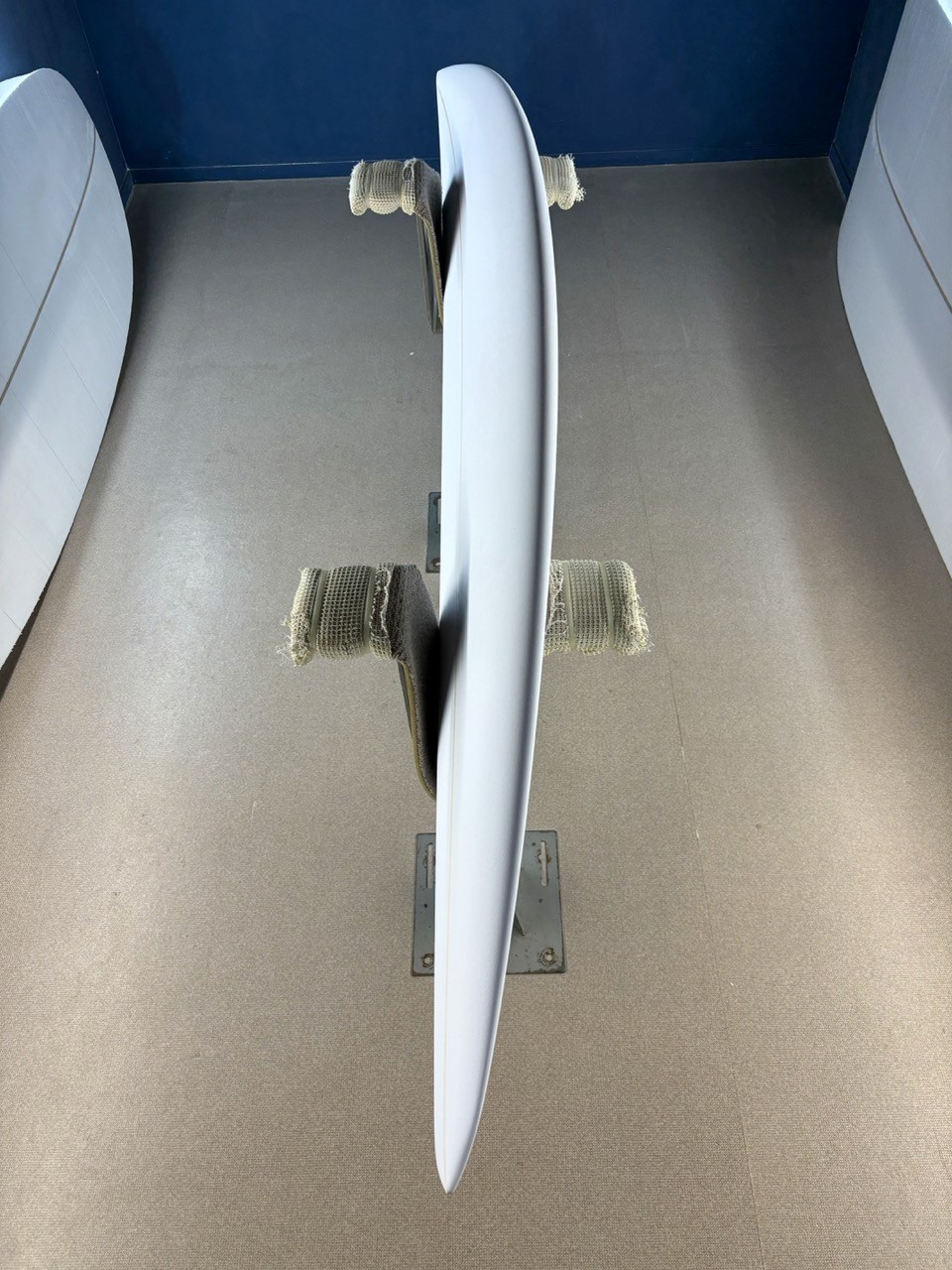
Eagle Nose × Flat Deck: Carrying Volume Through the Front
From the Eagle Nose through the center, the deck remains relatively flat, allowing us to retain volume through the front half of the board.
The purpose is not simply to add flotation.
That volume helps keep the board stable through takeoff and allows it to carry the energy of the wave smoothly into forward speed.
From the center, the foil gradually tapers toward the tail.
Volume up front to get the board moving.
A thinner tail for control.
The relationship between those two areas is an important part of the balance of this 7’2”.
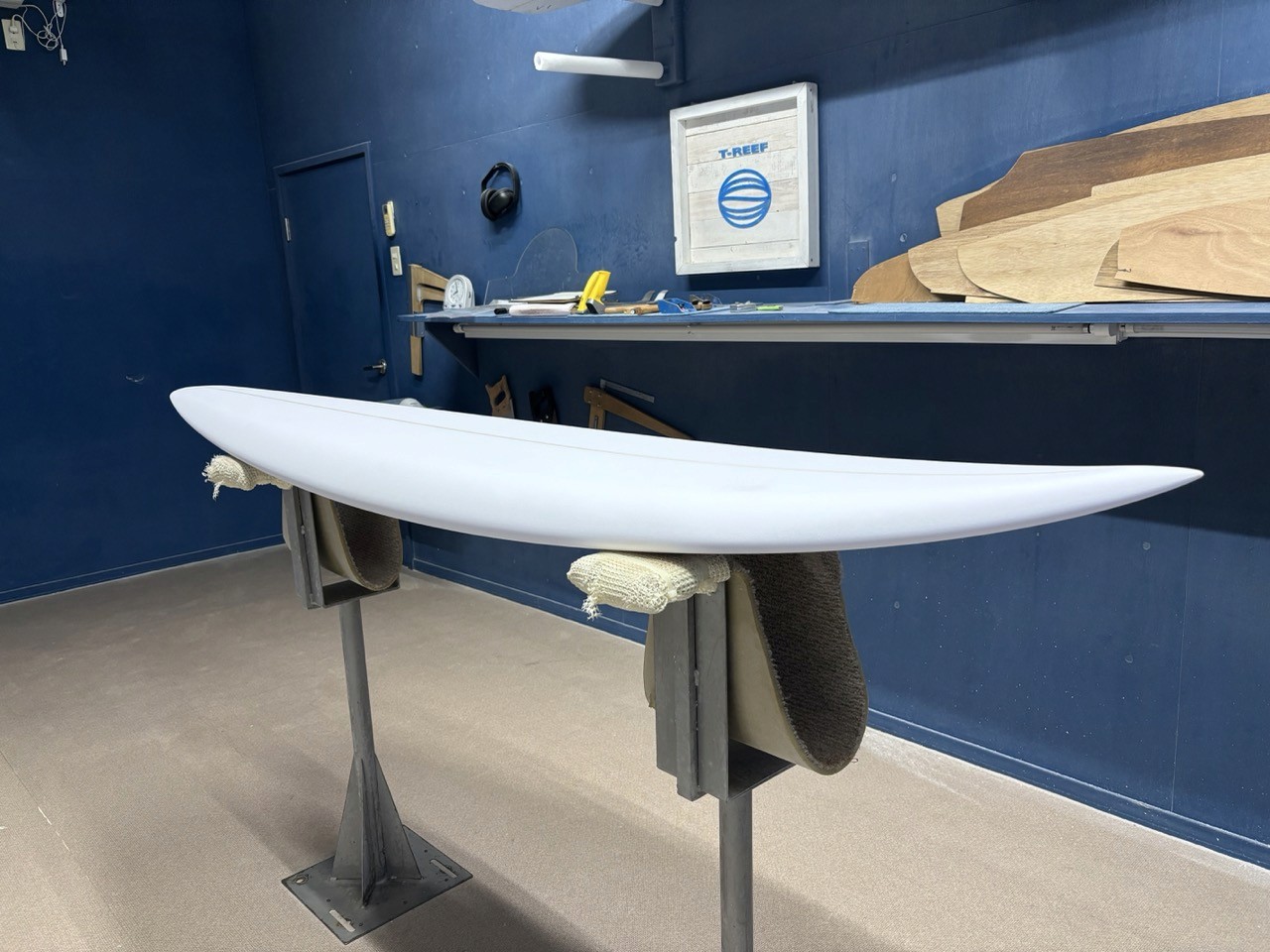
Soft V → Flat → Slide V: Managing Water Flow from Nose to Tail
The bottom runs from:
Soft V → Flat → Slide V
The Soft V through the nose allows the board to enter the water smoothly before transitioning into a flatter section through the center, where the board can generate and maintain speed.
Toward the tail, the bottom transitions into a Slide V, helping direct water toward the tail and release it cleanly to either side.
The bottom of a surfboard is not simply a collection of contours. Each transition affects how water moves beneath the board.
How the board receives water, how that flow travels along the bottom, and how it releases through the tail all contribute to the way the board accelerates and responds.
Catch → Carry → Release
This idea of Water Flow remains an important part of the way we approach surfboard design at T-REEF today.
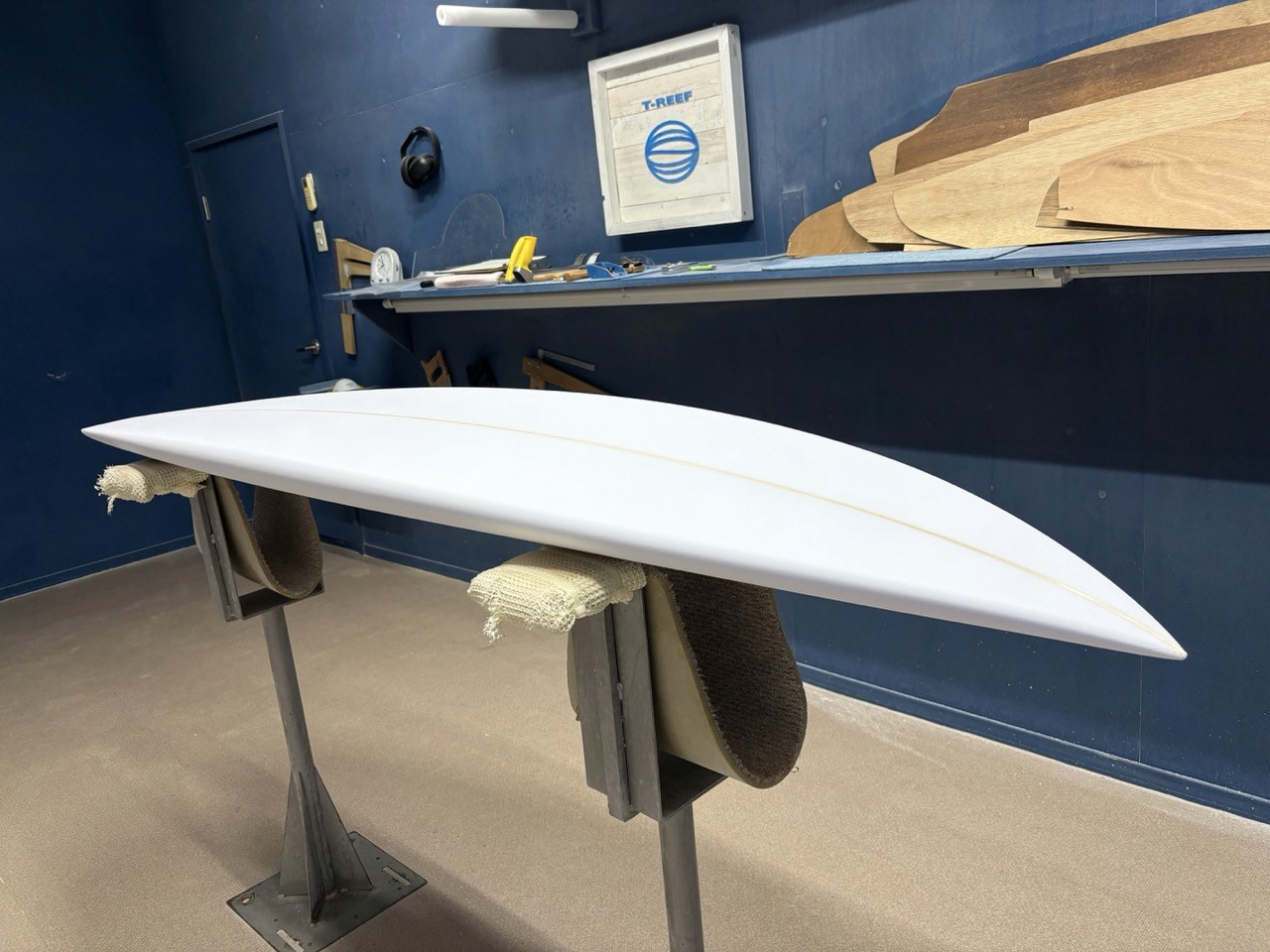
Down Rail × Baby Diamond Tail: Hold, Direction and Release
A Semi-Gun needs enough hold to stay connected to the face of the wave at speed, while still allowing the board to transition smoothly from one line to the next.
For this 7’2”, we paired a Down Rail with a Baby Diamond Tail.
The Down Rail gives the board a clean, positive engagement with the wave face, providing the hold needed through a longer, faster line.
The Baby Diamond Tail maintains a smooth curve through the tail while introducing a defined release point at the center. This helps preserve hold while allowing the board to transition into a turn without feeling locked in.
Through the bottom turn, the sequence becomes:
Rail Hold → Direction → Release
But none of these elements works in isolation.
On this board,
Tail Outline × Tail Foil × Down Rail × Bottom × Rocker
are designed to work together as one system.
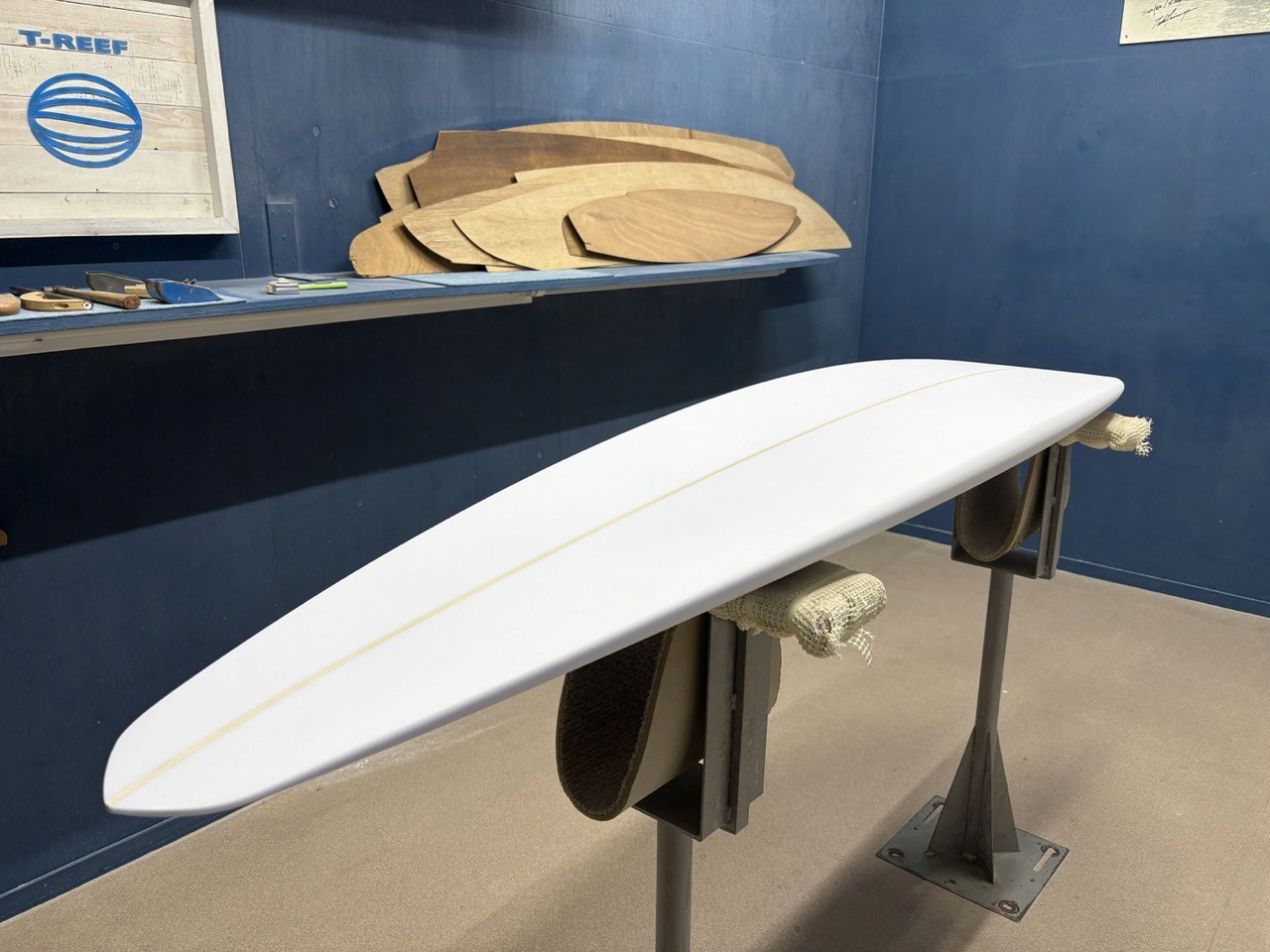
Gentle Rocker × Single Fin: Drawing a Longer Line
The rocker follows a smooth, gradual curve rather than an exaggerated one.
A Semi-Gun does not automatically need an aggressive rocker simply because it is designed for more powerful surf.
With this board, the priority is to let the energy of the wave generate speed naturally from takeoff, carry that speed into the bottom of the wave, and connect smoothly into the turn.
Toward the tail, the thinner foil allows the rocker to work without excess volume interfering with the board’s response.
The rocker defines the line.
The foil controls the response.
The board is finished with a Single Fin.
This 7’2” is not designed around a series of short, rapid direction changes. It is designed to establish a line on the face of the wave and carry it.
The entire board works with the energy of the wave, allowing the surfer to change direction without interrupting that flow.
The goal is not to make smaller movements, but to draw a longer line.
That is at the heart of this classic Semi-Gun design.

BRINGING A 50-YEAR-OLD DESIGN BACK TO THE SHAPING BAY
The feeling we are looking for from this 7’2” is:
Glide → Acceleration → Hold → Natural Motion
The board should enter the wave smoothly and accelerate as it picks up the energy of the wave.
At the bottom, the Down Rail engages with the face. Through the bottom turn, the surfer should not need to force the board into the next line. The transition should feel natural.
That feeling is not created by the Single Fin, Down Rail, Baby Diamond Tail, foil, bottom or rocker individually.
It comes from the relationship between all of them.
That relationship — and the Natural Motion it creates — is what I first experienced when I rode the original 7’2” Dick Brewer shaped for me in 1972.
There is, however, an important detail behind this particular project.
Brewer shaped the original board for me as a custom order. He did not teach me how to shape this particular design, nor did I inherit a template for it.
So before Shinnosuke could shape his own 7’2”, I went back to the original board I had kept for more than five decades.
I studied the outline again, traced the design, and made a new shaping template from scratch.

This was an important part of the process.
We were not simply using the finished board as a visual reference. By creating a template from the original, the outline became something that could be accurately carried into a new blank, and used again as part of the shaping process.
Shinnosuke then used that template to shape his own 7’2”.
For someone working toward becoming a shaper, receiving a template carries a different meaning from simply being shown how a finished board looks.
It becomes part of the knowledge and tools he can continue to learn from.
For us, the template and the board he shaped from it also mark a step in Shinnosuke’s apprenticeship at T-REEF.
But above all, this is what the board represents:
A 50-year-old design, understood and experienced firsthand by a new generation.
Not simply by preserving the original board, but by returning to the design, shaping it by hand, and eventually taking it back into the water.
That is where the design can truly be understood.
And for Shinnosuke, this 7’2” is the beginning of that experience.

Ride on Shinnosuke!
WANT TO ORDER YOUR BOARD?
Every T-REEF Surfboard is fully hand-shaped.
Each board is designed from scratch around your:
✔️ Surfing style
✔️ Body type
✔️ The way you want to surf
→ Learn more about our custom board process


