

7’2” SEMI-GUN / A Design Passed Down Through More Than 50 Years
Stories
Oct 1, 2026
There are things about a surfboard that numbers alone cannot explain.
Length, width, thickness.
Rocker, rails, tail.
They can all be measured. The same dimensions can even be reproduced.
But how a board moves through a wave, how it guides the surfer riding it, and how that experience is carried into the next board — and eventually, the next generation — cannot be told through numbers alone.
In November 2025, Shinnosuke shaped a 7’2” Semi-Gun during a T-REEF Shape Workshop.
The origin of that board goes back more than 50 years, to 1972, when my mentor, Dick Brewer, shaped my first 7’2” Semi-Gun for me.
This is the story of one surfboard design, passed down across more than half a century.
1972 — The 7’2” Semi-Gun That Became My Starting Point
In 1972, I traveled to Hawaii. I experienced surfing at Makaha and North Shore, and it was there that I met Dick Brewer.
The first board Brewer shaped for me was a 7’2” Semi-Gun.
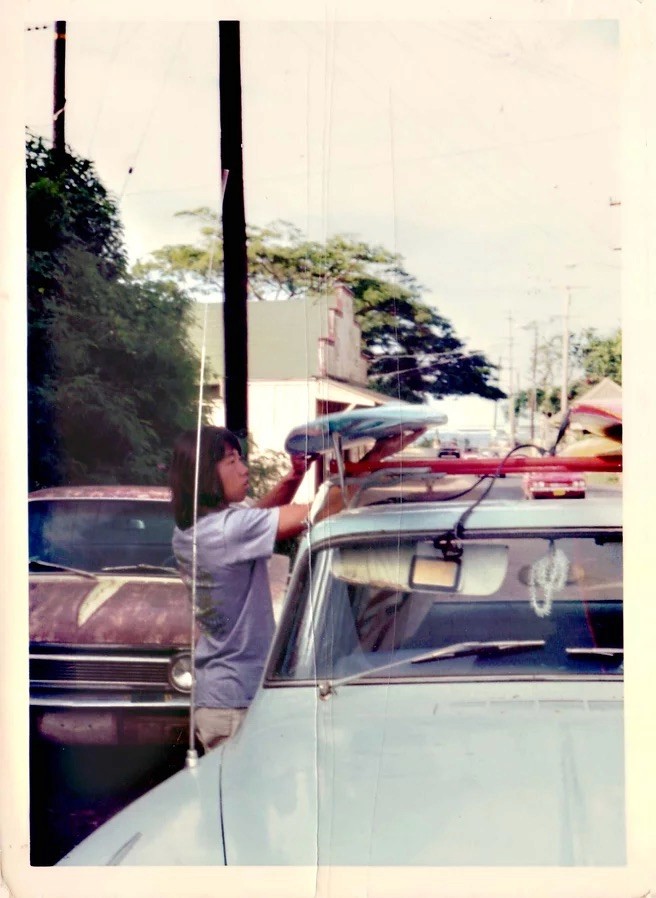
Original 7’2” Semi-Gun
7’2” × 18 1/2” × 3 1/8”
Nose / 12 1/2”
Tail / 11”
Baby Diamond Tail
Down Rail
Classic Foil
Single Fin
The bottom runs from:
Soft V → Flat → Slide V
The rocker follows a smooth, gentle curve, while the foil gradually thins toward the tail.
The deck carries generous volume from the Eagle Nose through the center, before progressively becoming thinner toward the tail, a classic Semi-Gun foil of that era.
But this was not simply a “thick board.”
Volume was kept where it was needed, then carefully reduced toward the tail.
That distribution of volume brought paddling, takeoff, stability and control together in a single design.
But I did not truly understand what this board meant when I first looked at its shape.
I understood it when I rode it.
“The Surfboard Was Guiding Me.”
In 1973, I paddled out at Inamuragasaki on a big day with that 7’2”.
From the moment I took off, the board accelerated smoothly and naturally, carrying me all the way down to the bottom of the wave.
Then came the bottom turn.
At that moment, it felt as though the board already knew where I wanted to go.
I did not feel like I was forcing it to turn.
The energy of the wave and the movement of the board connected naturally, and it carried me straight into the tube.
Inside, I experienced a world I had never known before.
There was no sound. No wind.
It almost felt as though I were surrounded by warm air, and yet I was moving at a speed I had never experienced in my life.
The adrenaline was incredible.
And in that moment, I realized something.
“I wasn’t controlling the surfboard.
The surfboard was guiding me.”
With the boards I had ridden before, I do not think I could even have made the takeoff in those conditions.
For the first time, I understood through my own body just how much the performance of a surfboard could transform the experience of surfing itself.
Looking back, I believe that experience was what led me into the world of surfboard design.
It was also the beginning of my journey toward becoming a shaper.
More than 50 years later, that same 7’2” is still with me today.

2025 — A Shape Workshop with Shinnosuke
More than half a century later, in November 2025, Shinnosuke joined his first T-REEF Shape Workshop.
He had already developed a strong interest in surfboard shaping.
What matters to me in a Shape Workshop is not simply taking a blank, shaping it and finishing a surfboard.
It is about understanding:
Why do we remove foam here?
Why does this line need to be shaped this way?
How will this form work once it enters the water?
The goal is to shape while understanding the reason behind every decision.
Then Shinnosuke made a request.
After seeing the original 1972 Dick Brewer 7’2” Semi-Gun that I still own, he said:
“I want to shape a board based on this exact design.”
Challenge accepted.

Bringing a 50-Year-Old Design Back to the Blank
The 7’2” Shinnosuke shaped was based on the design of the original 1972 Semi-Gun.
Shinnosuke’s 7’2” Semi-Gun
7’2” × 18 1/2” × 3 1/8”
Nose / 12 1/2”
Tail / 11”
Baby Diamond Tail
Down Rail
Classic Foil
Single Fin
The bottom follows the original transition:
Soft V → Flat → Slide V
Volume is maintained from the Eagle Nose through the center, before the foil gradually becomes thinner toward the tail.
But the important part was not simply matching the measurements of the 1972 board.
I wanted Shinnosuke to understand the reason behind those numbers.
Shape Is Not Just a Shape.
When I shape a surfboard, I am never looking only at its form.
Every line drawn into the blank has a purpose once it enters the water.
How water enters beneath the board from the nose.
How it travels along the bottom.
Where it changes direction, and where it releases.
How the rail engages with the face of the wave.
How the changing foil toward the tail influences control through a turn.
How the rocker creates a line from takeoff through the bottom turn.
No single element determines how a surfboard performs.
Everything is connected.
That is exactly what I learned from Brewer’s 7’2” in 1972.
And more than 50 years later, it was my turn to pass that understanding on to Shinnosuke through my own experience.
That was what this Shape Workshop was really about.

Passing Down the Design, Not Copying the Shape
When I talk about making “the same board,” I do not mean simply copying an old surfboard.
What I truly want to pass down is not only the physical shape of the foam.
It is the thinking behind it.
Why was it shaped this way?
In 1972, Dick Brewer made that 7’2” for me.
By riding it, I experienced the possibilities of surfboard design through my own body.
More than 50 years later, Shinnosuke and I stood in front of that same board and began reading its design again, this time through the shaping process.
From Brewer to me.
From me to Shinnosuke.
Reproducing the same dimensions matters less than making sure the next generation understands why those dimensions, and those lines, exist in the first place.
That is why this 7’2” carries three moments in time.
1972 — Dick Brewer
2025 — Tadao & Shinnosuke
And what comes next.
From one shaper to the next generation.

The Journey Continues
To me, shaping a surfboard has never been about creating a “finished shape.”
It is about continuing to explore the relationship between the wave, the surfer and the board.
When I rode Brewer’s 7’2” in 1972, I experienced something for the first time:
the feeling that the board was guiding me.
More than 50 years later, that feeling still lives within the boards I shape today.
And in 2025, Shinnosuke took the design that started it all and shaped it from a blank with his own hands.
An experience that began with one surfboard is passed on to the next surfer.
And then to the next shaper.
The shape continues.
The knowledge continues.
The journey continues.


